

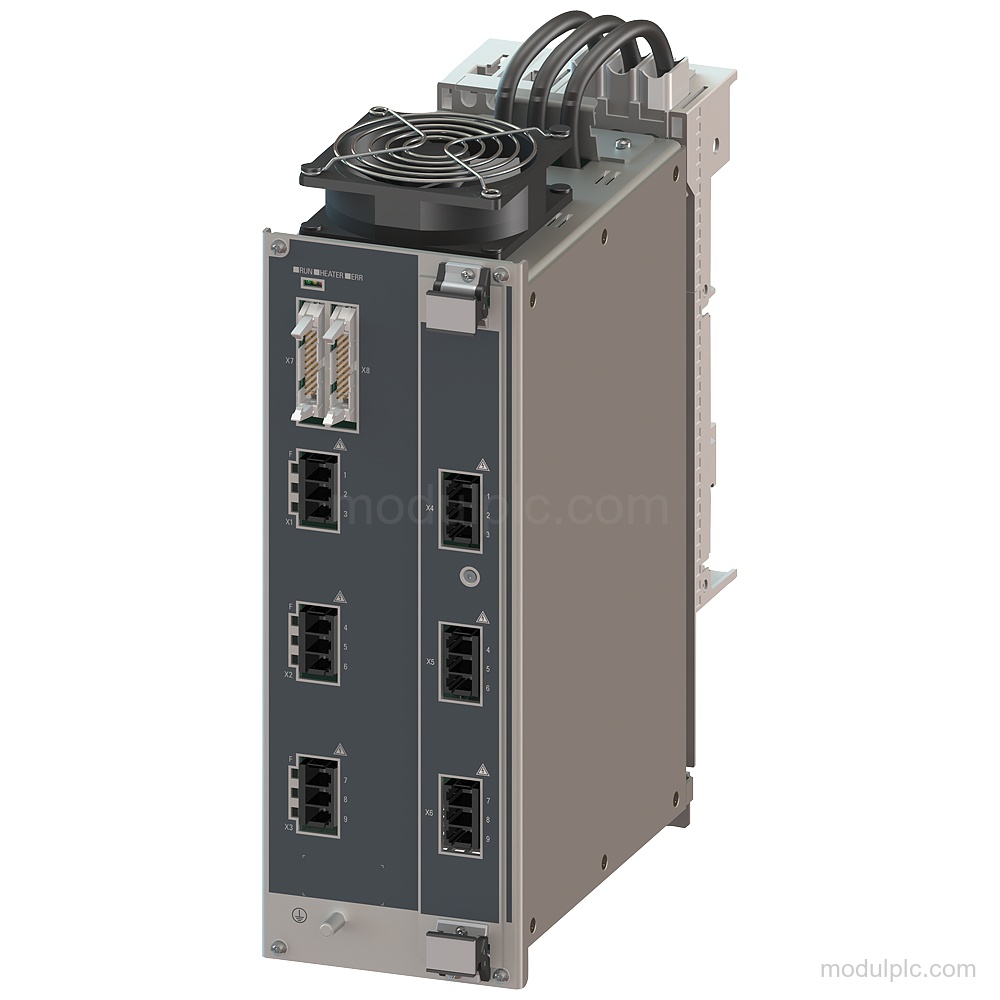
Product Overview
Technical Summary
| Parameter | Value |
|---|---|
| Product type | POM4320 BUSBAR MOUNTING (IEC) |
| Number of heating outputs | 9 |
| Supply voltage | 400 V; Phase – phase |
| Power carrying capacity per output | 200 W to 6 400 W; At 400 V AC |
| Mounting type | Busbar mounting |
| Output connection | plug, 3-pole with spring-type terminal, push-in |
| System interface | system interface |
| Protection degree | IP20 |
Applications
- Heating element control: Controls heating elements using half-wave control, soft start, and phase control.
Key Features
- Heating outputs: Has 9 heating outputs, with 1 heating element per output maximum.
- Heating power: Each output carries 200 W to 6 400 W at 400 V AC; high-inrush heating elements support up to 4 000 W at 400 V AC.
- Heating control: Supports half-wave control, soft start, and phase control.
- Supply and mounting: Uses 400 V AC phase-to-phase supply and vertical busbar mounting with self-ventilation.
- Connection: Supply connection is busbar mounting, 3-pole + PE. Heating and fan outputs use 3-pole plugs with push-in spring-type terminals.
- Diagnostics: Provides voltage diagnostics, temperature monitoring with an NTC thermistor, and detection of fuse, load, Triac, rotating field, communication, supply, line-voltage, and frequency faults.
Frequently Asked Questions
1. How many heating outputs does Siemens 6BK1943-2AA00-0AA2 have?
It has 9 heating outputs and supports 1 heating element per output maximum.
2. What heating power does each output support?
Each output supports 200 W to 6 400 W at 400 V AC. Heating elements with high inrush current support up to 4 000 W at 400 V AC.
3. How is the unit mounted and connected?
It uses vertical busbar mounting. The supply connection is 3-pole + PE, and the heating and fan output connection uses a 3-pole plug with a push-in spring-type terminal.
4. Which diagnostics are available?
It provides voltage diagnostics, temperature monitoring with an NTC thermistor, and fuse blown, load failure, Triac error, rotating field fault, communication error, supply voltage, line voltage, and frequency diagnostics.